- Reviews are the only evidence you get of how an end of lease cleaner behaves after the clean, when the agent inspects and flags something.
- The most useful reviews mention the outcome: the inspection, the agent’s feedback, the bond, and what happened when an item was flagged.
- Read the rating, the number of reviews and the dates together. A 4.8 across hundreds of recent reviews tells you more than a 5.0 across a dozen.
- Read the one to three star reviews first, and pay attention to how the business replied.
- Fake reviews breach the Australian Consumer Law, and Google does not allow reviews bought with incentives, so be wary of sudden bursts of generic five star praise.
- Reviews are half the picture. Before you book, check the ABN, the insurance, a written guarantee window in days, and a fixed price for your property.
Quick answer
How do you choose an end of lease cleaner from reviews?
Start with providers that have a strong rating across a large number of recent reviews on an independent platform such as Google. Read the most recent reviews and every low rated one, and look for specific mentions of passed inspections, returned bonds and return visits handled without fuss. Treat generic, bunched or incentivised praise with caution. Then confirm what reviews cannot show: an ABN, public liability insurance, a written reclean guarantee measured in days, and a fixed price for your property type. A provider that passes both tests is the safest choice for your bond.
Source: ACCC guidance on online reviews; Google Maps content policy; O2OCleaning Google Business Profile| What to check | What it tells you |
|---|---|
| Rating across a large number of reviews | Consistency over many jobs, not a lucky few |
| Dates of the most recent reviews | Whether the standard still holds today |
| One to three star reviews and the replies | How problems are handled |
| Mentions of inspections and bonds | Whether the reviews are about vacate cleans at all |
| Written guarantee, ABN and insurance | What happens if something goes wrong |
Why reviews matter more for end of lease cleaning
Most services give you a chance to judge the result yourself. An end of lease clean does not. The work is judged by someone else, the agent or property manager, often days after the crew has left, and against a report written at the start of your tenancy. By the time you find out whether the clean was good enough, you have usually handed back the keys.
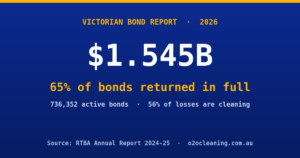
The stakes are also higher than the price suggests. A standard Victorian bond is four weeks’ rent, which comes to roughly $2,320 at Melbourne’s median rents (REIV, February 2025), and cleaning accounts for 56% of bond deductions (End of Lease Bond Disputes Report, 2025). You are not only buying a few hours of cleaning. You are choosing who you will depend on if the agent’s email arrives with a list of items.
That is exactly what reviews can show you and a website cannot. A company’s own pages will always describe the clean at its best. Reviews written by other renters describe what happened on ordinary days, including the ones that did not go perfectly.
Where to read end of lease cleaning reviews in Melbourne
No single platform gives the full picture, so it is worth reading more than one.
| Where | Good for | Watch out for |
|---|---|---|
| Google reviews on the business profile | The largest number of reviews, dates, and the owner’s replies | Ratings across every service the business offers, not just vacate cleans |
| Independent review sites, such as ProductReview.com.au | Longer, more detailed reviews | Smaller numbers for most local cleaners |
| Job marketplaces, such as hipages or Airtasker | Ratings tied to specific booked jobs | Ratings often reflect many kinds of tasks, not end of lease work |
| Facebook recommendations and local groups | Honest, informal feedback from neighbours | Very small samples and no verification |
| Testimonials on the company’s own website | Detail about the service | They are chosen by the business, so confirm them elsewhere |
Google is usually the best starting point because it combines volume, dates and public replies from the business. Use the other platforms to check that the picture is consistent. A business that is excellent on its own website and ordinary everywhere else has told you something useful.

What a useful end of lease cleaning review actually says
Star ratings are a summary. The text is where the evidence is. When you read reviews of end of lease cleaners, look for these details.
The outcome. The best reviews say what happened at the inspection: the agent signed off, the bond came back in full, or the property manager commented on the result. That is the only outcome that matters for this kind of clean.
The property. A mention of the suburb, the property type or the number of bedrooms tells you the reviewer had a real job done, and helps you judge whether their experience is relevant to yours.
The items that decide inspections. Ovens, rangehoods, shower glass, window tracks and carpets are where most vacate cleans are won or lost. A review that mentions them specifically is worth more than one that says “great clean”.
What happened when something was flagged. This is the most valuable detail of all. A review saying the agent raised one item and the crew came back the next morning, at no charge, tells you the guarantee works in practice, not just on paper.
The practical side. Arriving on time, answering messages, and charging the price that was quoted. These rarely decide an inspection, but they show how the business is run.
Short reviews are not fake. Plenty of genuine customers write a single line and move on. They simply carry less information, so give more weight to the detailed ones.
To see the difference, compare two illustrative examples. A thin review might read: “Great service, highly recommend.” A useful one might read: “Two bedroom unit in Carlton. The agent flagged the rangehood filter two days after the clean, the crew came back the next morning, and we got the full bond back.” The second tells you about the property, the problem, the response and the result.
If you want to see how this looks in practice, you can read tenant reviews of our end of lease cleans, or see what Melbourne tenants say in bond clean reviews across providers.
How to read the rating, the volume and the dates together
A rating on its own is easy to misread. Three numbers, read together, tell a much clearer story.
The rating. Anything from about 4.5 upwards is strong for a service business. A perfect 5.0 is not automatically better. Busy businesses eventually have a bad day, and a spotless record across a small number of reviews can simply mean not many jobs have been reviewed yet.
The volume. The more reviews, the less any single one can move the average. A 4.8 across several hundred reviews reflects hundreds of properties, agents and inspections. A 5.0 across twelve reflects twelve.
The dates. Sort by newest. The last few months tell you whether the standard that earned the rating still holds. Look at how the reviews are spread over time, too. A steady flow across several years suggests consistent work. A large cluster in a single week, followed by silence, is harder to trust.
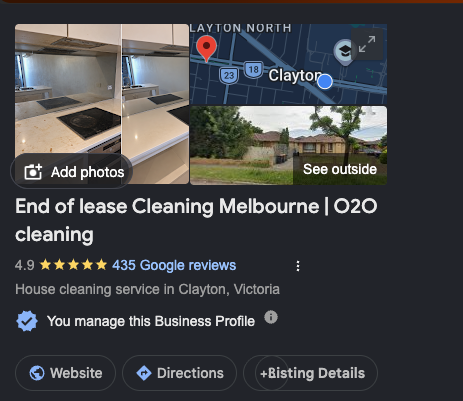
For reference, our own Google profile sits at 4.9 from 435 reviews at the time of writing. We would still suggest reading the lower ratings on our profile before the high ones, as you should for any provider.
The bad reviews tell you the most
It is natural to read the five star reviews first. The most useful habit is to do the opposite and start with the one, two and three star reviews.
When you read them, sort the complaints into types:
- A no show or a late cancellation, which matters a great deal if your handover date is fixed
- Items missed at inspection, which is common and forgivable if the business fixed them
- A refused return visit, which is a serious warning sign for an end of lease clean
- A price that changed on the day, which suggests an unclear scope or quote
- Damage during the clean, where the question is whether it was put right
One complaint of each kind is normal for a busy business. The same complaint repeated across several months is a pattern, and patterns are what you should avoid.
Then read the business’s reply. A good reply is calm, acknowledges the problem, explains what happened, and says what was done to fix it. A defensive reply that blames the customer, or no reply at all, shows you how you are likely to be treated if your own inspection goes badly. At the end of a lease, the way a business handles a complaint is more important than the complaint itself.
Red flags that a review profile is not genuine
Most reviews are real, but fake and incentivised reviews exist, and the rules around them are clear. Under the Australian Consumer Law, it is illegal for a business to write fake reviews, arrange for others to write them, or remove genuine negative reviews to mislead customers. Where a business offers an incentive for a review, the ACCC says the incentive must apply whether the review is positive or negative, and it must be disclosed (ACCC guidance on online reviews). Google goes further and does not allow businesses to offer payment, discounts or free services in exchange for reviews at all (Google Maps content policy).
Signs worth a closer look:
- A burst of five star reviews in a short period, especially after a long quiet spell
- Generic wording that could describe any business, with no suburb, property or detail
- Near identical phrasing across several reviews
- No negative reviews at all across a large number of jobs
- Offers of a discount or a gift in return for a five star review
- Reviewers who have reviewed nothing else, which is weak evidence on its own but adds weight to other signs
None of these proves a review is fake. Together, they are a reason to rely more heavily on another platform and on the checks in the next section.
Reviews are half the picture: verify the rest
Even the most convincing reviews cannot tell you everything. Before you book, confirm the things that protect you if something goes wrong.
- An ABN that checks out. Look it up free on the Australian Business Register and confirm the name matches. Ours is ABN 90 459 113 516.
- Public liability insurance. It covers damage during the job. We carry $5 million of cover.
- A written guarantee window measured in days. Ask whether it runs from the clean or the inspection, and what you need to do to claim it. Ours covers issues reported within seven days of the clean, and you can read how our 7 day bond back guarantee works.
- A fixed price for your property type. Compare quotes on the same scope rather than the headline figure. Our guide to end of lease cleaning cost in Melbourne explains how to do that.
- A written list of what is included and excluded, so nothing is left to memory when the agent inspects.
If you want to weigh several providers side by side, you can also compare Melbourne bond cleaning services in our comparison guide, and apply the same checks to each.

A ten minute method for turning reviews into a shortlist
You do not need hours of research to choose well. This short routine works for any provider.
- Search and shortlist three providers with a strong rating across a large number of reviews on Google.
- Read the twenty most recent reviews for each, and note how many mention inspections, agents or bonds.
- Read every one to three star review and the business’s reply.
- Look for a return visit story. At least one review describing a flagged item being fixed is a good sign.
- Check the ABN, the insurance and the written guarantee for each provider.
- Ask each for a fixed price for the same property and the same scope.
Then score each provider against the same questions:
| Question | Provider A | Provider B | Provider C |
|---|---|---|---|
| Strong rating across many recent reviews? | |||
| Reviews mention inspections and bonds? | |||
| Low ratings answered calmly and fixed? | |||
| At least one return visit handled well? | |||
| ABN, insurance and written guarantee confirmed? | |||
| Fixed price for the same scope? |
The provider with the most ticks is usually the right choice, even if it is not the cheapest quote.
What reviews cannot tell you
Reviews describe other people’s properties, other agents and other conditions. They cannot tell you how your own oven, shower glass or carpets will respond, or how strict your agent will be. That is why the written scope and the guarantee matter as much as the rating.
It is also worth knowing what your agent will actually look for. Reading what agents check at a vacate inspection helps you judge whether a provider’s reviews mention the right things.

Photos help here. Reviews and profiles that include before and after photos of real jobs, such as ovens and stovetops, show the standard a provider works to far better than a written claim.
Frequently asked questions
Are the reviews on a cleaning company’s website reliable?
They can be genuine, but they are chosen by the business, so they show the service at its best. Use them for detail about how the service works, and confirm the overall picture on an independent platform such as Google, where the business cannot pick which reviews appear.
How many reviews should an end of lease cleaner have?
There is no magic number. What matters is enough reviews, spread over enough time, that no single one can distort the average. A long record of steady reviews over several years is more reassuring than a large number posted recently.
Can a cleaning company delete its bad Google reviews?
A business cannot simply delete a review on its Google profile. It can report a review that breaks Google’s policies, and it can reply publicly. Removing or hiding genuine negative reviews to mislead customers is also a breach of the Australian Consumer Law.
Should I just use the cleaner my agent recommends?
You can choose your own provider. An agent’s recommendation can be a good starting point, because agents see the results of many cleans, but apply the same checks: reviews, ABN, insurance, a written guarantee and a fixed price.
What if a cleaner does not honour its guarantee?
Put the request in writing with the agent’s list and your photos, and keep the invoice. If the provider still will not fix items that were within the agreed scope, you can seek advice from Consumer Affairs Victoria. An honest, factual review of what happened also helps the next renter.
Does a bond back guarantee mean the cleaner pays my bond?
No. A bond back guarantee means the provider returns and cleans again, at no charge, any item within the agreed scope that the agent flags within the guarantee window. It does not mean the provider refunds your bond, which is why the length of the window matters so much.
The short version
Reviews are the best evidence you have of how an end of lease cleaner behaves when something goes wrong. Read the rating, the number of reviews and the dates together, start with the low ratings, look for mentions of inspections, bonds and return visits, and be wary of generic bursts of praise. Then confirm what reviews cannot show: an ABN, insurance, a written guarantee in days and a fixed price for your property.
If you would like a quote from a provider that meets every one of those checks, our end of lease cleaning service in Melbourne starts from $245 with a written scope and a seven day reclean guarantee.
Sources: ACCC guidance on online reviews for businesses and review platforms; Google Maps user contributed content policy; End of Lease Bond Disputes Report, 2025; REIV median rents, February 2025; O2OCleaning Google Business Profile, September 2026.