Table of Contents
Introduction
Here’s what most tenants get wrong about bond disputes: they think the problem is effort. It isn’t. The problem is sequence, focus, and proof.
According to the Residential Tenancies Bond Authority, 95% of bond repayments in Victoria are resolved by mutual agreement — no VCAT, no lawyers, no drama (RTBA 2023–24). The remaining 5% that escalate to disputes? They’re almost always about cleaning standards and missing documentation.
We’ve seen this pattern play out hundreds of times across Melbourne rentals. What follows is the end-to-end process that keeps tenants on the right side of that 95%.
If you’d rather skip straight to what your property needs, our end of lease cleaning price guide for Melbourne breaks down costs by bedroom count and property type.

Why Do Most Bond Disputes in Melbourne Happen?
Cleaning disputes account for 56% of all bond deductions in Australia, making it the single biggest reason tenants lose money at the end of a lease (End of Lease Bond Disputes Report, 2025). Around 34% of tenants experience some form of bond deduction — and one in four lose money specifically because of cleaning or minor maintenance issues.
The core issue isn’t dirt. It’s a gap between what tenants consider “clean enough” and what agents assess against their checklist. Under the Residential Tenancies Act 1997, tenants must return a property in “reasonably clean” condition, accounting for fair wear and tear (Consumer Affairs Victoria, 2026). But “reasonably clean” is subjective — and that’s where disputes start.
Three things eliminate most of that ambiguity:
- A predictable cleaning sequence that covers every surface agents check
- Targeted effort on hotspots — oven interiors, shower screens, grout lines
- Timestamped photos that prove condition at handover
So how do you actually get this right? Let’s start with the cleaning order that prevents rework.
What Is the “Dry First, Wet Last” Cleaning Rule?
Professional cleaners follow a two-part sequence that cuts rework by roughly 40%: dry tasks first, wet tasks second — and always top to bottom (Consumer Affairs Victoria, Guideline 2). This isn’t a preference. It’s physics.
In our experience cleaning Melbourne rentals, we’ve found that tenants who mop first and dust second end up re-doing floors. Dust settles downward. Moisture spreads outward. When you reverse the order, every step undoes the last one.
Here’s the sequence that works:
- Dry tasks: Dusting, vacuuming, scraping, brushing cobwebs
- Wet tasks: Mopping, degreasing, descaling, wiping surfaces
- Direction: Ceiling → walls → benchtops → floors
This matters even more in Melbourne’s climate. High humidity in bathrooms (especially winter) means moisture lingers. If you apply cleaning product to tiles before removing dust and hair, you’re creating a paste — not cleaning.
Worth noting: this sequence applies to every room. Don’t jump between wet and dry across rooms. Complete each room’s dry phase before switching to wet.
What Do Agents Actually Check at Final Inspection?
According to Consumer Affairs Victoria, rental providers must complete exit condition reports within 10 business days of a lease ending, and tenants have the right to be present during the final inspection (Consumer Affairs Victoria, 2026). Knowing exactly what’s on their checklist gives you a major edge.
Here’s what gets flagged most often, based on our cleaning data across Melbourne:
| Area | Hotspot Items | Fail Rate |
|---|---|---|
| Kitchen | Oven interior, cooktop edges, rangehood filters, splashback grease | High |
| Bathroom | Shower screen, grout lines, silicone edges, exhaust fans, drains | High |
| Windows | Glass clarity, tracks (debris), flyscreens | Medium |
| Floors | Corners, skirting boards, sticky patches, carpet marks | Medium |
| Walls | Fingerprints near switches, scuffs, cobwebs at ceiling line | Low–Medium |
The kitchen and bathroom together account for the vast majority of re-clean requests. If you only have limited time, that’s where to focus.
For a printable version of this list with tick-boxes, see our end of lease inspection checklist for Melbourne.Top 5 Inspection Fail Points in Melbourne RentalsOven Interior

How Far in Advance Should You Start Cleaning?
The average wait time for a disputed bond return exceeds 30 days once it reaches VCAT or RDRV mediation (Tenants Victoria, 2026). Compare that to the 1 business day it takes for an agreed bond refund to process through the RTBA. That’s a strong incentive to get it right the first time.
Here’s the timeline we recommend for a 1–3 bedroom Melbourne rental:
T-7 to T-4 days: Prepare and declutter
- Remove all personal items and rubbish
- Take “before” photos of every room (wide-angle + close-ups)
- Identify problem areas: mould, grease buildup, carpet stains
- Buy supplies or book an end of lease cleaning service
T-3 to T-2 days: Detail clean (dry → wet, top → bottom)
- Complete the room-by-room checklists below
- Focus extra time on kitchen and bathroom
- Address any identified problem areas
T-1 day: Final reset and evidence
- Quick walk-through: light dust, spot-mop any footprints
- Take “after” photos matching every “before” angle
- Photograph receipts for any professional cleaning or pest control
Handover day: Walk-through and key transfer
- Attend the final inspection in person (it’s your legal right)
- Bring printed copies of before/after photos
- Note any disagreements in writing on the spot
Timeline beats intensity. A rushed 4-hour clean the night before creates disputes. A structured 7-day process doesn’t.
Why Is Photo Evidence Your Best Insurance Against Bond Claims?
Under the Residential Tenancies Act 1997, condition reports are the primary evidence used to resolve bond disputes at VCAT (Consumer Affairs Victoria, 2026). But condition reports have a flaw: they’re completed weeks or months before you move out, and they capture text descriptions — not visual proof.
Consumer Affairs Victoria requires rental providers to complete exit condition reports within 10 business days of the tenancy ending, and renters have the right to be present during this process. Critically, renters can “modify inaccurate details and add comments” to any condition report they disagree with (Consumer Affairs Victoria, 2026).
Your photo evidence fills the gap. Here’s what to capture:
- Wide-angle room shots — every room, every angle
- Close-ups of known problem areas — oven interior, shower screen, grout
- Before/after pairs — same angle, clearly showing improvement
- Receipts — for professional cleaning, carpet cleaning, or pest control
- Timestamps — keep your phone’s location and date stamps on

Keep everything in a dedicated folder (Google Drive or iCloud) and email a copy to yourself — this creates an independent timestamp the agent can’t dispute.
Room-by-Room Cleaning Checklists
These checklists follow the dry-first, top-to-bottom sequence for each room. They’re based on what Melbourne agents actually flag — not generic cleaning advice.
Kitchen: Degrease First, Polish Last
Kitchens fail inspections more than any other room. The oven interior alone triggers re-cleans in the majority of cases we see.
Sequence: Scrape/dry remove → degrease → rinse → polish

- Lift stovetop parts — clean burner edges, knobs, and drip trays
- Soak rangehood filters in degreaser (30 min minimum)
- Clean oven interior: racks, glass door (both sides), base, and sides
- Wipe all cabinet fronts, handles, and visible shelves
- Degrease splashback tiles — agents run a finger along these
- Descale tap base and drain rim with bathroom descaler
- Clean inside the dishwasher filter and door seal
- Vacuum floor corners and behind fridge, then mop last
Don’t forget the fridge interior. Even if your lease says “as-is,” a dirty fridge signals neglect to the inspector.
Bathroom: Hard Water and Soap Scum
Melbourne’s water is moderately hard — 50 to 100 mg/L calcium carbonate depending on your suburb. That means mineral buildup on glass, taps, and tiles is normal, but agents still expect it removed.
Sequence: Dry dust → apply descaler → dwell 10 min → scrub → rinse → squeegee
- Remove soap scum from shower screen — finish with a squeegee for streak-free glass
- Treat mould in grout and silicone early (apply, wait, scrub — don’t just wipe)
- Dust exhaust fan cover and surrounding ceiling area
- Disinfect toilet: hinges, rear base, rim, and behind the seat
- Pull hair from drains and wipe the drain rim
- Descale taps, showerhead, and any chrome fixtures
- Clean mirror edges and any medicine cabinet interior
If mould is embedded in silicone sealant (it goes black inside the caulk), no amount of scrubbing will fix it. That’s fair wear and tear under Victorian law — don’t let an agent claim otherwise.
Living Areas and Bedrooms
- Wipe skirting boards with a dry microfibre cloth
- Clean fingerprints from light switches, door handles, and power outlets
- Dust visible wardrobe shelves, rails, and drawer interiors
- Clear cobwebs from ceiling corners and around light fittings
- Vacuum edges and corners before final floor finish
- Spot-clean any scuff marks on walls with a damp magic eraser
Windows and Tracks
Sequence: Vacuum track → detail brush corners → wet wipe → glass polish
- Vacuum window tracks first — wet wiping dirty tracks creates mud
- Use a detail brush (old toothbrush works) for track corners
- Clean glass in sections, buffing dry immediately to prevent streaks
- Lightly dust flyscreens — don’t wet them, it pushes dust into the mesh
What Tools and Products Do You Actually Need?
Professional end of lease cleaning in Melbourne costs between $300 and $550 for a 2–3 bedroom property.
If you’re doing it yourself, here’s what you need — total cost under $100.
- Microfibre cloths (6–10) — colour-coded: one set for kitchen, one for bathroom
- Grout brush + detail brushes — for tracks, corners, and tile lines
- Descaler — for bathroom mineral buildup (look for citric acid-based)
- Degreaser — for kitchen splashbacks and rangehood (sugar soap works too)
- Vacuum with crevice tool — essential for skirting edges and window tracks
- Squeegee — for shower screens and glass (streak-free finish)
- Magic eraser sponges — for wall scuffs and light switch marks
- Gloves and mask — especially for oven cleaner and mould treatment

Should You DIY or Hire a Professional Cleaner?
End of lease cleaning costs in Melbourne range from $200–$300 for a studio to $550–$800 for a 4+ bedroom house, with hourly rates around $55–$85 per cleaner (End of Lease Cleaning Pricing in Melbourne 2026).
Whether that’s worth it depends on your situation.DIY vs Professional End-of-Lease Clean (2-Bed Melbourne)

DIY makes sense when:
- The property is already well-maintained weekly
- You have 8–10 hours available across 2–3 days
- Tasks can be split among housemates
- You’re comfortable cleaning ovens and shower screens thoroughly
Professional cleaning makes sense when:
- Tight inspection deadlines (less than 3 days)
- Larger properties (3+ bedrooms) or heavy grime buildup
- Carpet cleaning or pest control is a lease requirement
- You want a bond-back guarantee (most pros offer re-clean if agents reject)
One thing to know: since March 2021, Victorian landlords can only require professional cleaning if the property was professionally cleaned before you moved in and they told you so in writing (Tenants Victoria, 2026). If they didn’t disclose that? You only need to clean to a “reasonably clean” standard. When the deadline is tight or the property needs heavy work, booking a professional bond cleaning service takes the guesswork out of meeting that standard.
How Should You Handle a Re-Clean Request?
Even with thorough cleaning, re-clean requests happen. The RTBA processed over 252,000 renter enquiries in 2023–24, with bond repayment claims being the most common issue (RTBA Annual Report 2023–24). Don’t panic — but don’t ignore it either.
Here’s the measured approach:
- Request an itemised list — Ask the agent for specific items with photos. “The property isn’t clean enough” isn’t a valid claim.
- Check: cleaning issue or damage? — Agents sometimes bundle damage claims with cleaning. These are legally different. You’re not liable for fair wear and tear.
- Propose a short re-clean window — 24–48 hours is reasonable. Put it in writing (email, not phone calls).
- Keep all communication written — Email creates a paper trail for VCAT if needed.
- Update your evidence photos — Take new photos after the re-clean, matching the agent’s flagged items.

If the agent refuses reasonable re-clean attempts or claims bond for items that are clearly fair wear and tear, you can apply to RDRV (Rental Dispute Resolution Victoria) for free mediation. Only if that fails does it escalate to VCAT. Landlords can claim up to $40,000 in a single bond and compensation application, but they must prove losses with evidence — not just opinions.
For a deeper walkthrough of the VCAT process, see our guide on how to defend your bond claim at VCAT.
What Are Your Legal Rights Around Bond Returns in Victoria?
According to the RTBA Annual Report 2023–24, of all repaid bonds in Victoria, 64% were fully refunded to tenants, 26% were split between tenant and landlord, and only 10% went entirely to the rental provider (RTBA, 2024). These numbers mean the odds are firmly in your favour — if you document properly.
Key legal rights every Melbourne tenant should know:
| Your Right | Legal Basis | What It Means |
|---|---|---|
| Be present at final inspection | RTA 1997, s.97 | The agent must give you reasonable opportunity to attend |
| Not pay for fair wear and tear | Consumer Affairs Victoria | Faded paint, minor carpet wear, and small nail holes aren’t your problem |
| Modify condition reports | RTA 1997, s.35 | You can correct inaccurate details and add comments |
| Free RDRV mediation | Consumer Affairs Victoria | No cost to dispute a bond claim through mediation first |
| 10 business day claim window | RTBA rules | Landlord must start a claim within 10 business days or lose the right |
| VCAT depreciation rules | Tenants Victoria | Carpets depreciate 10% per year — a 5-year-old carpet is worth half its replacement cost |
Can an agent blacklist you for disputing a bond claim? No. Tenants cannot be listed on tenancy databases simply for challenging claims at RDRV or VCAT (Tenants Victoria, 2026). Blacklisting is only permitted if VCAT orders compensation exceeding the bond amount — which is rare.
Frequently Asked Questions
What is the most common reason for bond disputes in Melbourne?
Cleaning disputes account for 56% of all bond deductions in Australia, making it the single biggest cause. The most frequently flagged items are oven interiors, shower screens, and rangehood filters. Mismatched standards between tenants and agents — combined with a lack of photographic evidence — turn minor cleaning gaps into formal disputes (End of Lease Bond Disputes Report, 2025).
What cleaning standard is legally required at the end of a lease in Victoria?
Under the Residential Tenancies Act 1997, tenants must return a property in “reasonably clean” condition, comparable to its state at the start of the tenancy — accounting for fair wear and tear. You’re not required to leave the property cleaner than when you moved in. Since March 2021, landlords can only require professional cleaning if the property was professionally cleaned before your tenancy and you were informed in writing (Consumer Affairs Victoria, 2026).
How long does it take to get a bond refund in Victoria?
Agreed bond refunds are processed within 1 business day through the RTBA. However, if a dispute arises, the process can take 30+ days — passing through RDRV mediation and potentially a VCAT hearing. In 2023–24, 95% of all bond repayments were resolved by mutual agreement without reaching VCAT (RTBA Annual Report 2023–24).
When should I hire a professional end-of-lease cleaner instead of DIY?
Consider professional cleaning if you have fewer than 3 days before inspection, the property has heavy grime or mould, your lease requires carpet steam cleaning, or you want a bond-back guarantee. Professional end of lease cleaning in Melbourne costs $350–$550 for a 2–3 bedroom property and takes 3–4 hours — compared to 8–10 hours DIY. Most professional services include a free re-clean guarantee if the agent rejects the result.
Can my landlord keep my bond for fair wear and tear?
No. Under Victorian law, rental providers cannot claim bond for fair wear and tear — which includes faded paint, minor carpet traffic marks, small nail holes, and general aging of fixtures. VCAT applies ATO depreciation guidelines: for example, carpets depreciate at 10% per year, so a 5-year-old carpet is valued at half its replacement cost. If your landlord claims for wear-related items, you can dispute the claim through free RDRV mediation (Tenants Victoria, 2026).
The Three Things That Prevent Bond Disputes
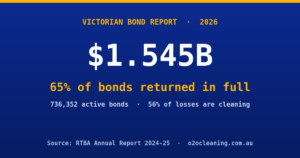
With 732,125 active bonds held by the RTBA as of June 2024 — valued at $1.456 billion — the stakes are real for Melbourne tenants (RTBA Annual Report 2023–24). But the formula for getting your bond back is simpler than most tenants think.
It comes down to three things:
- Follow the right cleaning sequence. Dry before wet, top to bottom, kitchen and bathroom first. Don’t improvise.
- Focus on what agents actually check. Oven interiors, shower screens, rangehood filters, window tracks, and grout lines — not the bits you see every day.
- Build evidence that eliminates ambiguity. Timestamped photos, before/after pairs, and receipts for any professional services.
That’s it. Ninety-five percent of Victorian bonds are resolved without dispute. The tenants who end up in the other 5% almost always skipped one of those three steps.
For more context on what Melbourne bond disputes actually look like in numbers, check out our bond dispute statistics breakdown. And if you’re in a suburb we cover — from End of Lease Cleaning Clayton to Richmond — our team can handle the entire process with a bond-back guarantee.
Need help close to your handover date? Get in touch and we’ll match you with a Melbourne cleaner in your area.
For more help in the same end of lease cleaning topic, see Bond claim in Victoria: how to start, meet deadlines, and win your refund.
For more help in the same end of lease cleaning topic, see What Should You Prepare When Find A Bond Cleaning Company?.