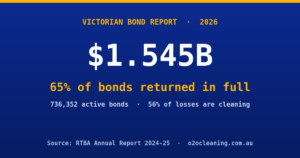
The bathroom is the single biggest reason renters lose part of their bond at exit. Under s.60 of the Residential Tenancies Act 1997 (Vic), you must leave the bathroom in a “reasonably clean” condition — not professionally cleaned, but the standard is strict on soap scum, grout, mould and the exhaust fan. Use the room-by-room checklist below, photograph every surface before and after, and you give yourself the best shot at the 64% of Victorian renters who got their full bond back last year (RTBA Annual Report 2023-24).
End of Lease Bathroom Cleaning Checklist: What Property Managers Check in Melbourne
Your bathroom is where bond money is won or lost. The average Victorian bond now sits around $1,988, calculated from the 732,125 active bonds worth $1.456 billion held by the RTBA as of 30 June 2024 (RTBA Annual Report 2023-24). That is a lot of money riding on a small, humid room.
This guide is the bathroom-specific section of a full end of lease clean. It tells you exactly what Melbourne property managers check, the legal standard you have to meet, and the items that catch out almost every renter, the exhaust fan, the silicone seal, and the grout. Read it once before you start. Then work through it surface by surface.
What “Reasonably Clean” Means for Bathrooms (Victorian Law)
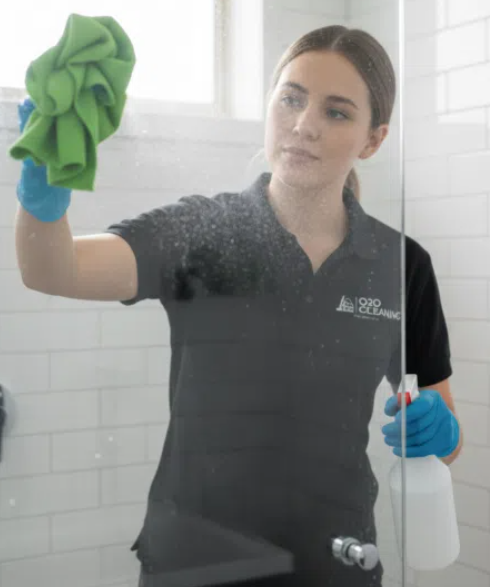
Victorian law does not require your bathroom to look new. It requires it to be “reasonably clean”. Under s.60 of the Residential Tenancies Act 1997 (Vic), as interpreted by Consumer Affairs Victoria, the bathroom must be free from dirt, dust, stains, soap scum and mould caused by failure to take care. That last phrase is the key. Wear is allowed. Neglect is not.
The legal difference between fair wear and tear and a cleaning failure decides whether your bond is touched. A faded grout line from five years of showers is wear. A black ring of soap scum at the base of the screen is failure to take care. A worn tap handle is wear. Limescale crusted around the spout is cleaning. Property managers are trained to spot the difference, and so should you.
Cleaning is also the single most common reason renters lose money at exit. In Queensland’s most recent figures, cleaning accounted for 21.4% of all bond claim reasons in 2023-24 (Queensland RTA Annual Report 2023-24), more than damage, more than rent arrears. Victoria does not publish the same breakdown, but every Melbourne agent we work with reports the same pattern, and the bathroom leads the list.
What Property Managers Actually Check in the Bathroom
Property managers move fast at inspections, usually 10 to 15 minutes for a whole apartment, but they slow right down in the bathroom. They look in the same order, at the same spots, every time. The table below is what a Melbourne agent ticks off against your entry condition report.
| Area | What They Check | Inspection Method | Priority |
|---|---|---|---|
| Shower screen | Soap scum, water spots, edges of glass, hinges | Held at angle against light | High |
| Grout lines (walls) | Pink mould, black mould, discolouration | Close visual, sometimes phone torch | High |
| Toilet (bowl, seat, cistern) | Under rim, base, hinge bolts, cistern top | Lift seat, look under rim with torch | High |
| Vanity and sink | Inside cupboard, overflow hole, plug, taps | Open every door and drawer | High |
| Taps and fixtures | Limescale, water spots, base of tap | Touch and visual | Medium |
| Exhaust fan | Dust on cover, blades inside, vent | Look up, sometimes remove cover | High |
| Floor tiles and grout | Corners, behind toilet, edges | Squat or kneel to check | High |
| Mirror | Streaks, toothpaste spots, edges | Angle and light test | Medium |
| Floor drain | Hair, scum inside grate | Lift cover if accessible | Medium |
| Silicone and caulking | Mould, lifting, gaps | Close visual along all joins | High |
If you only have one hour, spend it on the High Priority rows. That is where the inspection passes or fails.
End of Lease Bathroom Cleaning Checklist (Item by Item)
This is the working checklist. Total time for a standard one-bathroom apartment is around 2 to 3 hours if the bathroom has been cleaned regularly, and 4 to 5 hours if it has not. Work top to bottom so you never re-dirty a clean surface.
| Item | Task | Time | Notes |
|---|---|---|---|
| Ceiling and cornices | Wipe with microfibre on a flat mop, check for mould spots | 5 min | Use diluted vinegar on any spots |
| Exhaust fan cover | Unclip cover, soak in warm soapy water, wipe blades with cloth | 15 min | See our bathroom fan guide |
| Light fittings | Wipe globe and shade, remove dead insects | 5 min | Turn power off first |
| Mirror | Spray glass cleaner, wipe with microfibre, finish with newspaper | 5 min | Angle-check against light |
| Wall tiles and grout | Descaler spray, dwell 10 min, scrub grout with stiff brush | 30 min | See our grout cleaning guide |
| Shower screen | Apply descaler or vinegar paste, leave 15-20 min, scrub, rinse | 25 min | Hinges and tracks too |
| Shower head and rail | Soak head in vinegar bag for 30 min, scrub holes | 10 min active | Tie bag with rubber band |
| Taps and fixtures | Vinegar-soaked cloth wrapped around, leave 10 min, polish | 10 min | Use old toothbrush at base |
| Toilet bowl | Toilet cleaner under rim, brush, wipe seat both sides, base and bolts | 15 min | Lift seat fully off if possible |
| Vanity outside | Wipe doors, handles, sides, kick panel | 10 min | Check skirting |
| Vanity inside | Empty, vacuum, wipe shelves and drawer runners | 15 min | Agents always open these |
| Sink and overflow | Clean bowl, scrub overflow hole with toothbrush, polish plug | 10 min | Overflow hole gets missed |
| Silicone seals | Inspect for mould, treat with bleach gel if needed | 15 min | See mould section below |
| Floor tiles and grout | Sweep, mop, scrub grout in corners and behind toilet | 20 min | See our bathroom floor guide |
| Floor drain | Remove cover, clear hair, scrub grate and inside | 10 min | Wear gloves |
| Door and frame | Wipe both sides, handle, hinges, kick area | 5 min | Check back of door |
| Skirting and edges | Wipe full length, including behind door | 5 min | Often missed |
Tick each row as you go. If something needs a second pass, leave it and come back after the descaler has done its work, scrubbing wet surfaces with dry product wastes time and elbow.
The Hardest Bathroom Problems (and How to Fix Them)
Four problems cause more bond deductions than the rest combined. Each one has a technique that works, and a technique that wastes your afternoon. In our experience cleaning over a thousand Melbourne bathrooms, the difference is almost always dwell time, letting the product sit long enough to break the bond between the dirt and the surface before you scrub.
Soap scum on the shower screen
Spray the whole screen with a commercial descaler or a 1:1 white vinegar and dish soap mix. Leave it 15 to 20 minutes. Do not scrub during this time. Then work top to bottom with a non-scratch scourer, rinse, and squeegee dry. Stubborn corners get a second pass. Never use steel wool on glass.
Grout staining
Make a paste of baking soda and a small amount of water. Apply along the grout line with an old toothbrush. Spray white vinegar on top, it will fizz. Let it sit 10 minutes, then scrub with a stiff grout brush in tight circles. Rinse with a wet cloth. For darker stains, swap vinegar for hydrogen peroxide. Heavily stained grout that will not lift is often classified as wear, photograph it and note it in your move-out documentation.
Hard water limescale on taps
Soak a paper towel in white vinegar. Wrap it around the tap and base. Cover with a small plastic bag and elastic band. Leave 30 minutes. Remove, scrub the base with a toothbrush, and polish with a dry microfibre. Melbourne water is moderately hard, so this build-up is common in older fittings and usually lifts cleanly.
Mould on silicone seals
Apply a bleach-based mould gel directly to the silicone. Cover with cling film to stop it drying out. Leave for 2 to 6 hours, longer for older stains. Wipe off, rinse, and dry. If the mould has grown into the silicone itself rather than on the surface, the silicone may need replacing, which is usually a landlord responsibility (see mould section below). Always ventilate the room when using bleach products.
Mould in the Bathroom: Who Is Responsible?
This is the question that decides more disputes than any other. The rule is simple in principle, messy in practice. Tenant-caused mould from poor ventilation, leaving wet towels on the floor, or not running the exhaust fan is the tenant’s responsibility. Structural mould from a leaking pipe, a failing roof, a cracked window seal, or rising damp is the rental provider’s responsibility.
CAV’s “reasonably clean” definition specifically names “mould caused by failure to take care” as the tenant’s problem. The “caused by” matters. If you can show the mould has reappeared after cleaning, or has spread from behind a fixed surface, or sits under bubbling paint, it is almost certainly structural.
Two practical examples we see often. First, a black ring along the bottom edge of the shower silicone in an apartment with a working exhaust fan, that is tenant mould and you need to clean it. Second, dark spots spreading up a wall behind the toilet in a ground floor flat, that is almost always rising damp or a slow leak, and it is the landlord’s job to fix. Photograph it. Email the agent before you move out, and keep the reply.
Do You Need Professional Cleaning for End of Lease?
Short answer, no, not by default. Since 29 March 2021, Victorian landlords cannot require professional cleaning at the end of a tenancy unless two conditions are both met. The lease has to contain a specific professional cleaning clause, and the property must have been professionally cleaned before you moved in. If either is missing, the requirement is unenforceable (Tenants Victoria).
So when does it make sense to hire someone? Three situations. First, the bathroom has heavy soap scum, mould, or limescale you cannot lift in a weekend. Second, you are time-poor and cleaning DIY would mean an extra day of rent overlap, that maths often favours hiring. Third, you want the bond-back guarantee, where a professional clean is re-done free if the agent rejects it. You can compare against our end of lease pricing before deciding.
If You Fail the Bathroom Inspection, What Happens Next
You have more rights than most renters realise. The numbers are actually encouraging. In 2023-24, 64% of repaid bonds in Victoria went fully to the renter, 26% were split, and only 10% went entirely to the rental provider (RTBA Annual Report 2023-24). Even better, 95% of bond cases were settled by mutual agreement, never reaching VCAT.
If the agent claims part of your bond for bathroom cleaning, the process runs like this. The rental provider must give you the exit condition report within 10 business days of you handing back the keys (Consumer Affairs Victoria). You then have 14 days to respond if you disagree. If agreement fails, the RTBA holds the bond and you can apply for free mediation through the Dispute Settlement Centre of Victoria (DSCV). If that fails, the case goes to VCAT.
At every stage, evidence wins. Photographs with timestamps, dated emails, receipts for products or services, copies of the entry condition report. See the full CAV dispute pathway for the exact forms.
Documentation, Protect Yourself Before and After
The single highest-return 20 minutes of your move-out is the photo walk. Every surface in the bathroom needs a before photo taken on cleaning day, and an after photo taken once you finish. Take them on a phone with location and timestamp enabled. Then email them to yourself so you have a server-side date.
Capture the shower screen from the side and front, all four corners of the floor, every grout line on the walls, the toilet from above and at the base, inside the vanity, the exhaust fan cover, both sides of the door, every tap, the mirror, and any pre-existing damage. Wide shots first, then close-ups. Match the angles in your entry condition report if you have it.
Store them in a cloud folder labelled with the property address. If you used a cleaner, save the invoice and the company’s guarantee terms in the same folder. This bundle is what wins disputes at the DSCV mediation stage without ever needing VCAT.
DIY vs. Professional, The Real Cost Comparison
The right choice depends on the state of your bathroom, the time you have, and the size of your bond. Melbourne’s median weekly rent is now $580 (DFFH Victoria Rental Report, Sep 2025 quarter), which means each extra day in the property costs you about $83. That changes the maths quickly.
| Factor | DIY | Professional |
|---|---|---|
| Time required (bathroom only) | 2-5 hours | Included in full-property clean |
| Products needed | $40-$80 (descaler, grout brush, mould gel, microfibres) | Included |
| Risk if it fails | You re-clean or lose bond | Free re-clean under bond-back guarantee |
| Indicative cost (whole house) | $40-$80 | $320-$490 for typical 2-3 bedroom |
| Best for | Light bathrooms, cleaned regularly | Heavy build-up, deep mould, tight timeline |
For a 3-bedroom 2-bathroom in Melbourne, our standard end of lease price is $490 without carpet, $655 with carpet steam clean, both backed by a bond-back guarantee with a free re-clean if the agent doesn’t pass it. O2O Cleaning holds a 4.9-star Google rating across 300+ Melbourne end-of-lease cleans. Our professional bond cleaning service covers every surface in the checklist above. Compare that against a partial bond loss of $200-$500 and the choice is usually clear.
For a fuller room-by-room reference across the whole property, see our end of lease inspection checklist for Melbourne.
FAQ
How long does end of lease bathroom cleaning take?
A standard one-bathroom apartment takes 2 to 3 hours if it has been cleaned regularly during the tenancy. Bathrooms with heavy soap scum, mould on silicone, or limescale on fixtures often take 4 to 5 hours because most of that time is dwell time, letting descaler and mould gel work before scrubbing.
Can the landlord charge for normal bathroom wear?
No. Under Consumer Affairs Victoria rules, fair wear and tear cannot be deducted from your bond. Faded grout, slightly worn tap finishes, and discoloured silicone that cannot be cleaned away are all wear. Soap scum, mould from poor ventilation, and dirty surfaces are not, and those are chargeable.
Is exhaust fan cleaning required for end of lease?
Yes, every Melbourne agent we work with checks the exhaust fan, and a dust-clogged cover is one of the most common reasons for a partial re-clean. Unclip the cover, soak it in warm soapy water for 10 minutes, wipe the blades inside with a damp microfibre, and dry before refitting. Our bathroom fan guide has the full step-by-step.
What if the mould came from a leaking pipe?
That is the rental provider’s responsibility, not yours. Structural mould from leaks, rising damp, or failed seals falls outside the tenant’s duty to keep the property “reasonably clean”. Photograph it, email the agent to report it before you move out, and keep the reply. If a bond claim is made, that evidence is usually enough to defeat it at DSCV mediation.
Can I clean it myself without a professional?
Yes. Since 29 March 2021, Victorian landlords cannot require professional cleaning unless the lease has a specific clause and the property was professionally cleaned before move-in (Tenants Victoria). A DIY bathroom clean to “reasonably clean” standard is legally sufficient. Hiring a professional is a time and risk decision, not a legal one.
What if I disagree with the exit condition report?
You have 14 days from receiving the exit condition report to respond. If you and the agent cannot agree, the RTBA continues to hold the bond and you can apply for free mediation through Dispute Resolution Victoria. Last year 95% of Victorian bond cases settled this way and never reached VCAT (RTBA Annual Report 2023-24). See the full CAV dispute pathway for forms and timelines.
For more help in the same cleaning tips topic, see How to Disinfect Wood Without Damaging the Finish and What is O2OCleaning? Melbourne’s Trusted End of Lease Cleaning Experts.
For more help in the same end of lease cleaning topic, see How to Clean Surface areas Properly for End of Lease Cleaning.